

You’ll notice something subtle if you enter the East London Mosque on a Friday right before one o’clock. With his voice rising and falling in that well-known rhythm, the imam starts the khutbah in classical Arabic before transitioning almost instantly into English.
Not precisely translation. It’s more of a continuation. Near the back, the young men in hoodies slant slightly forward. The elder uncles in the front row, who were raised listening to sermons in Urdu or Bengali, also nod in agreement. It’s a minor issue. However, it reveals a lot about the future of British Islam.
| Subject Snapshot | Details |
|---|---|
| Topic | Bilingual worship culture in London mosques |
| Primary location | Tower Hamlets, Brent, Newham, Ealing — East and West London |
| Estimated UK Muslim population | Around 4 million, with the largest concentration in Greater London |
| Languages typically heard in services | Arabic (Qur’anic recitation), English (sermons, Q&A), Urdu, Bengali, Somali, Turkish |
| Oldest major mosque referenced | East London Mosque (origins in the London Mosque Fund, 1910) |
| Notable annual public initiative | Visit My Mosque — now in its seventh year, run by the Muslim Council of Britain |
| Number of participating mosques in 2024 | More than 200 across the United Kingdom |
| Common bilingual sermon format | Arabic verses recited, followed by English exegesis, sometimes mixed with regional dialect |
| Audience demographic shift | Second and third-generation British Muslims, plus converts and curious non-Muslims |
| Broader cultural backdrop | Ramadan lights on Oxford Street, halal aisles in supermarkets, rising Muslim political representation |
Mosques in London functioned on an unspoken linguistic divide for many years. The mother tongue for everything else and Arabic for the sacred text. If you were a teenager from Newham or Tower Hamlets who grew up listening to grime music and reading GCSE English literature, you frequently sat through Friday prayers knowing very little. Speaking with younger members of the congregation gives the impression that this was once commonplace. It seems like a lost chance now.
Although it has been quietly occurring for years, the trend toward bilingual worship—Arabic combined with English instead of a heritage language—has accelerated since the pandemic. Imams suddenly had audiences dispersed throughout the nation and occasionally the world when mosques shifted their sermons online during lockdown. English turned into the useful glue. Whether this was strategic or merely practical is still up for debate. Most likely both.
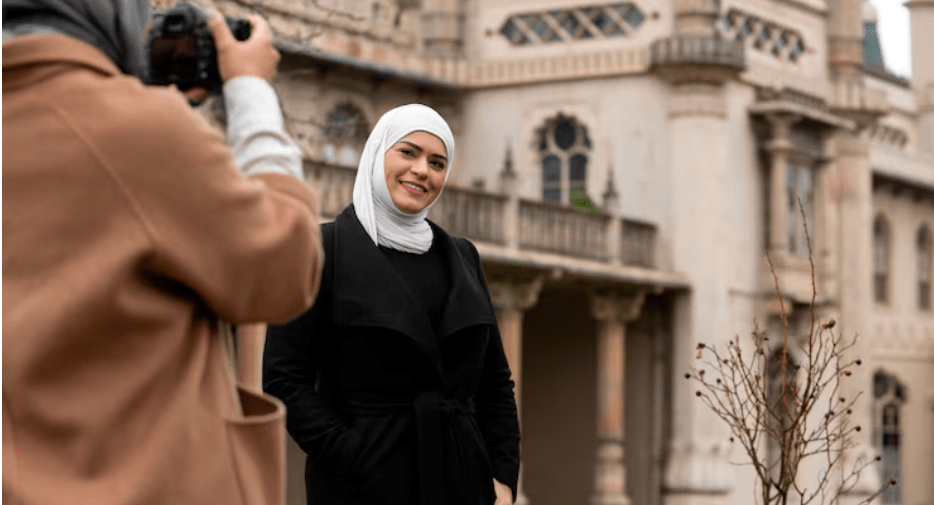
You could observe the new model in action at the East London Mosque, which recently reopened to the public as part of the Muslim Council of Britain’s Visit My Mosque weekend. In addition to tours that included TED-style talks, calligraphy stands, and an exhibition of Qur’anic manuscripts, visitors of all faiths were given tea and cake, which was very British and thoughtful. Speaking about being Muslim in Britain, Nathan Gubbins, a politics and engagement officer there, incorporated allusions to the Qur’an into a speech that, to be honest, sounded more like a university lecture than a traditional dars.
It’s difficult to ignore how important this is to converts. Colin John, a mental health practitioner who accompanied his Muslim friends, said he was impressed by how inclusive Islam is. For years, he had been interested. That curiosity might never have crossed the threshold in the absence of an English-language entry point.
Of course, this has a longer history. Muslim ties to Britain date back to the eighth century, when King Offa of Mercia struck coins with the Arabic Kalimah on them. In the 1630s, Chairs of Arabic were established at Oxford and Cambridge. The Qur’an was first translated into English in 1649. Thus, it is not new for these two languages to coexist on British soil. The congregation is paying attention, which is new.
This change is being spearheaded by younger imams, many of whom were born in Britain and received some training in Cairo or Medina but are fluent in London’s rhythms. One minute they are talking about Premier League football, and the next they are talking about tafsir. The sacred is being diluted, according to some traditionalists. On the other hand, some contend that meaning is ultimately what matters.
Observing this unfold, it’s remarkable how natural it seems. It doesn’t appear to have been mandated. It is emerging through thousands of tiny decisions made in carpeted prayer halls, on YouTube channels, and in WhatsApp groups shared between cousins, as is the case with most cultural shifts. It remains to be seen if it results in a more self-assured British Islam or just one that is easier to understand. However, the shift has arrived. As soon as the imam clears his throat, you can hear it.
London Bilingualism's content on health, medicine, and weight loss is solely meant for general educational and informational purposes. This website does not offer any diagnosis, treatment recommendations, or medical advice.
We consistently compile and disseminate the most recent information, findings, and advancements from the medical, health, and weight loss sectors. When content contains opinions, commentary, or viewpoints from professionals, industry leaders, or other people, it is published exactly as it is and reflects those people's opinions rather than London Bilingualism's editorial stance.
We strongly advise all readers to consult a qualified medical professional before acting on any medical, health, dietary, or pharmaceutical information found on this website. Since every person's health situation is different, only a qualified healthcare provider who is familiar with your medical history can offer you advice that is suitable for you.
In a similar vein, any legal, regulatory, or compliance-related information found on this platform is provided solely for informational purposes and should not be used without first obtaining independent legal counsel from a licensed attorney.
You understand and agree that London Bilingualism, its editors, contributors, and affiliated parties are not responsible for any decisions made using the information on this website.
