

Nick Nugent still finds it difficult to describe a particular moment. A man wearing a stocking cap slipped discreetly into the back row on the first night of his international marketing course at Boston College’s Carroll School of Management in January 2014. At first, Nugent, a thirty-year college professor who had taught on three continents and written more articles than he could remember, assumed it was just a basketball player who was running late. The hat then fell off. “Jesus Christ, that’s Kobe Bryant,” he thought.
It was. Bryant was in Boston with the Lakers, who were playing the Celtics later that week, and it seemed that he thought it would be a good idea to spend an evening sitting through a two-hour marketing lecture. He was there the whole time. After that, he signed autographs. By the time the class ended, word had spread like wildfire across campus, and about two hundred people had gathered outside Fulton Hall. Before midnight, Nugent received roughly 150 emails. “Nothing got me anywhere near the notoriety,” he later said to WBZ-TV, “of this young 35-year-old man dropping by my class.”
The celebrity of that evening isn’t what makes it noteworthy. It speaks volumes about the real Kobe Bryant, a man who never went to college, never sat through a freshman orientation, never stayed up late studying a textbook, and yet had a desire to learn that most graduates never fully cultivate.
The day Kobe Bryant graduated from Lower Merion High School in Ardmore, Pennsylvania, marked the end of his formal education. By then, he had already surpassed Wilt Chamberlain’s previous record for the most points scored in southeastern Pennsylvania, finishing with 2,883 career points and winning national Player of the Year honors with a sense of quiet inevitability. By all standards, he was the nation’s top high school basketball player. For him, attending college was a diversion rather than a step forward.
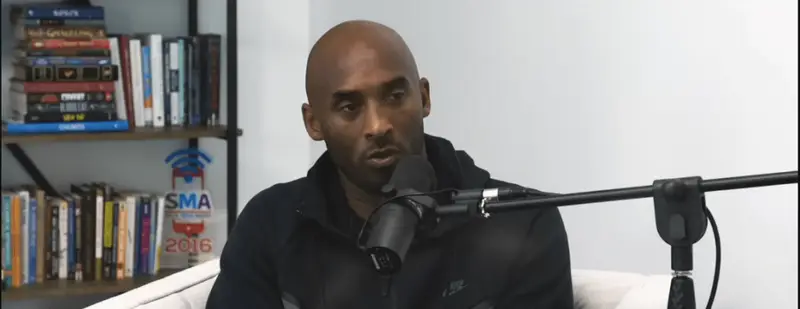
Before all of that, Kobe’s upbringing in Italy—where his father, Joe “Jelly Bean” Bryant, played professionally for eight seasons—shaped his mind. Living overseas, learning Italian, and growing up in a foreign culture were all experiences that could not be replicated in a classroom. Being the outsider in a room and observing how those around you behave when they are unaware that you are observing them can impart a certain kind of knowledge. Kobe was listening.
He excelled at Lower Merion in the United States, not only in athletics but also in a competitive spirit that was almost academic in its accuracy. Watch a movie. repetition. The way an engineer comprehends load-bearing walls is similar to how they comprehend the geometry of angles on a court. He became the second youngest player in NBA history when he joined the league at the age of seventeen after the Charlotte Hornets selected him 13th in the 1996 draft and promptly traded him to the Lakers. Although he was learning on the job, it was at the highest level.
He might have been saved by not attending college. In the late 1990s, the NBA was a university unto itself. Bryant learned things that no marketing curriculum could have taught him while playing with Shaquille O’Neal and under Phil Jackson, one of the sport’s most philosophically unique coaches. Jackson’s triangle offense required basketball IQ on par with chess. Bryant eventually became proficient enough to score 81 points in a single game on January 22, 2006, which is the second-highest individual total in NBA history.
A man who skipped college and then willingly spent two hours in a professor’s marketing class on a Boston game-week night has an almost peculiar quality. However, that’s the Kobe Bryant that his education truly produced—someone who realized that education doesn’t end when a career reaches its pinnacle. He was a poet. He produced movies. In 2018, he received an Academy Award for Dear Basketball. In his book The Mamba Mentality, which reads more like a philosophy than a sports memoir, he described a method for mastery and preparation.
As his story has developed over time, it seems that Kobe Bryant realized something about education that formal institutions frequently overlook: curiosity is the engine, not the credential. A diploma was never necessary for him. All he had to do was keep learning. And he never stopped, according to most accounts.
London Bilingualism's content on health, medicine, and weight loss is solely meant for general educational and informational purposes. This website does not offer any diagnosis, treatment recommendations, or medical advice.
We consistently compile and disseminate the most recent information, findings, and advancements from the medical, health, and weight loss sectors. When content contains opinions, commentary, or viewpoints from professionals, industry leaders, or other people, it is published exactly as it is and reflects those people's opinions rather than London Bilingualism's editorial stance.
We strongly advise all readers to consult a qualified medical professional before acting on any medical, health, dietary, or pharmaceutical information found on this website. Since every person's health situation is different, only a qualified healthcare provider who is familiar with your medical history can offer you advice that is suitable for you.
In a similar vein, any legal, regulatory, or compliance-related information found on this platform is provided solely for informational purposes and should not be used without first obtaining independent legal counsel from a licensed attorney.
You understand and agree that London Bilingualism, its editors, contributors, and affiliated parties are not responsible for any decisions made using the information on this website.
