

A laptop running the Bluebook app and a paper exam booklet sitting side by side on the desk are the first things you see when you enter a testing room for the AP Precalculus exam. The most obvious indication that this exam is designed differently from most of what students have prepared for is the combination of digital and analog in one sitting.
The answer to how long it runs is three hours. However, the three hours are divided into four separate parts that alternate between using a calculator and not using one, as well as between typing answers onto a screen and handwriting them in a booklet. Students who were aware of this perform noticeably better than those who weren’t.
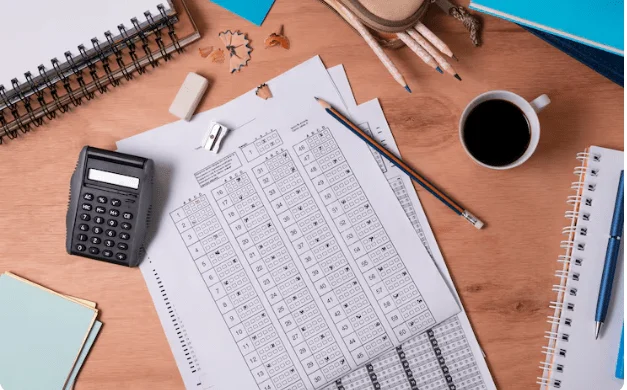
There are 40 multiple-choice questions in Section I, which lasts two hours. Part A consists of 28 questions spread over 80 minutes; calculators are not allowed. Here, the test assesses proficiency with algebraic manipulation, including manipulating polynomial expressions, changing functions, and thinking about domains and ranges without the aid of a graphing tool. Part A is where the time pressure first becomes apparent for many students, especially those who have learned to use the calculator as a first rather than a last resort.
Each question takes roughly one minute and forty-three seconds. Not generous, but not impossible either. After that, Part B changes to 12 questions in 40 minutes with the calculator allowed. This is a shorter section that assesses a variety of abilities, especially in regard to exponential, logarithmic, and trigonometric relationships, where the graphing tool really helps to visualize function behavior.
The exam’s hybrid nature is most evident in Section II, which consists of an hour of free answer. For two lengthy questions, Part A provides 30 minutes and a calculator; Part B removes the calculator once again for two more questions in an additional 30 minutes. Although the replies are handwritten in the paper booklets, both sections are seen on the Bluebook app, where students may see the prompts on the screen.
In actuality, the shift is a minor but significant change. Under pressure, handwriting and typing feel different. Compared to students who completed all of their practice digitally and saw the paper booklet format for the first time on exam day, those who practiced free-response work on paper throughout the year are better prepared for this.
Strong performance on part I gives a considerable buffer for the free-response part, while weak multiple-choice work is difficult to entirely compensate for with strong free-response responses due to the 62.5/37.5 score weighting, where multiple choice carries the higher share.
The practical implication is that in order to achieve the highest possible score, students must be proficient in both modes: algebraic fluency without the need for a calculator and the ability to organize and effectively explain multi-step answers on paper. Polynomial and rational functions, exponential and logarithmic relationships, and trigonometric and polar functions are all covered in the AP Precalculus course. These three conceptually separate topics, each with unique requirements, are assessed over the period of three hours.
The exam’s structure, which consists of four sections, two scoring weights, two calculator policies, and two answer media, is more logistically complicated than the material occasionally implies. For students who have continuously participated in the course, the arithmetic itself is challenging but doable.
The structure necessitates a new kind of preparation: learning how to switch between modes, comprehending which tools are available in which segment, and developing the pacing habits necessary to complete 40 multiple-choice questions and four free-response questions within the allocated time. The three hours often seem shorter to students who approach that as something they must solve on the day.
London Bilingualism's content on health, medicine, and weight loss is solely meant for general educational and informational purposes. This website does not offer any diagnosis, treatment recommendations, or medical advice.
We consistently compile and disseminate the most recent information, findings, and advancements from the medical, health, and weight loss sectors. When content contains opinions, commentary, or viewpoints from professionals, industry leaders, or other people, it is published exactly as it is and reflects those people's opinions rather than London Bilingualism's editorial stance.
We strongly advise all readers to consult a qualified medical professional before acting on any medical, health, dietary, or pharmaceutical information found on this website. Since every person's health situation is different, only a qualified healthcare provider who is familiar with your medical history can offer you advice that is suitable for you.
In a similar vein, any legal, regulatory, or compliance-related information found on this platform is provided solely for informational purposes and should not be used without first obtaining independent legal counsel from a licensed attorney.
You understand and agree that London Bilingualism, its editors, contributors, and affiliated parties are not responsible for any decisions made using the information on this website.
