

There’s a part of Pancho’s story that sticks in your memory more than the technical details, and it’s only known by that name in published research. His first decoded sentence, generated by electrodes placed against his brain and deciphered by a University of California, San Francisco artificial intelligence system, was straightforward: “My family is outside.” It was delivered in English. However, Pancho is a native Spanish speaker who spent his childhood dreaming, arguing, and laughing in Spanish before suffering a devastating stroke at the age of twenty that left him paralyzed and speechless. He learned English later, after the harm had already been done. Spanish was the native tongue.
A group of almost a dozen researchers, under the direction of neurosurgeon Edward Chang, spent years creating something that had never been done before: a bilingual neuroprosthesis that could decode both Spanish and English from a single person’s brain activity in real time and display the intended speech on a screen. This gap between what the machine could do and what the patient actually needed drove the team. The findings, which were published in Nature Biomedical Engineering in May 2024, feel more like a door opening onto uncharted territory than a small step forward.
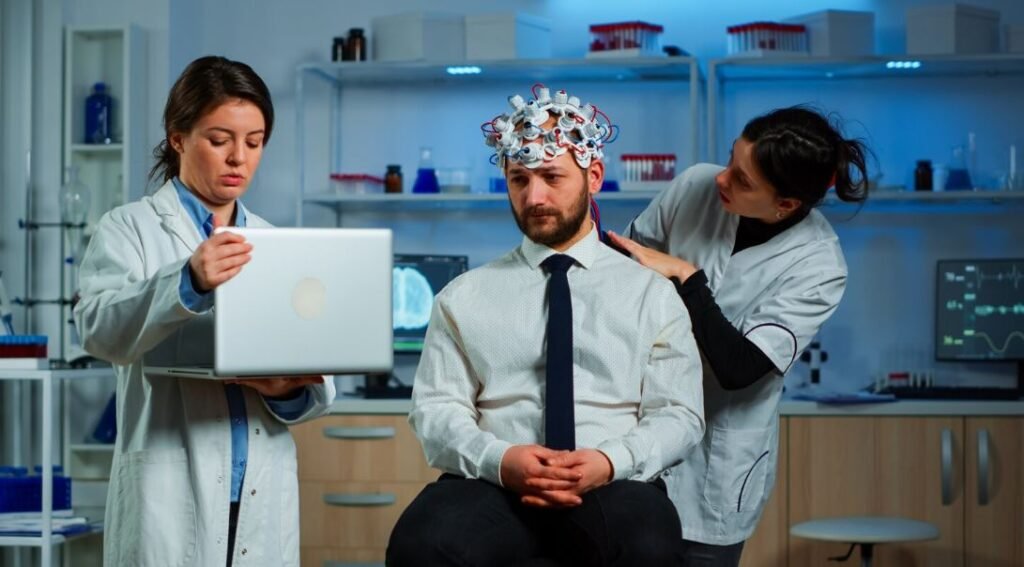
Because it reveals something genuinely unexpected about how language functions in the brain, the technical architecture is worth considering. Previous non-invasive research had proposed a sort of geographical sorting in which distinct languages activate distinct brain regions. However, Chang’s group discovered that a large portion of the cortical activity for both Spanish and English came from the same region when they looked at the signals detected by Pancho’s implanted electrode array. The brain wasn’t storing languages in different drawers, according to Alexander Silva, a doctoral student working on the project, who called it an unexpected convergence. In a way, it was putting them through circuitry that overlapped.
The team trained an AI system with two parallel modules, one for each language, based on that realization. Pancho tried to speak about 200 words during training sessions, and the electrodes recorded the unique neural signature that each attempt generated. When both modules were put into use, they would compete to create a likely sentence from incoming brain signals, choosing words one at a time using linguistic probability and neural pattern matching. Whichever version—Spanish or English—had the highest overall confidence score was shown on the screen facing Pancho. The system produced the correct text approximately 75% of the time and identified the correct language from the first decoded word with 88% accuracy—numbers that are not perfect but impressive considering what was being tried.
Beyond the engineering, there’s a feeling that this work’s bilingual component is important. Chang asserts that a person’s identity is closely associated with the languages they speak. The long-term goal was to restore connection rather than just replace words. Observing Pancho eventually engage in open, language-switching discussions with the research team—selecting Spanish when it felt appropriate and English when it didn’t—indicates that the technology had an impact on something more personal than vocabulary retrieval.
The generalizability of these findings is still unknown. Despite learning English as an adult, Pancho’s brain responses did not differ significantly from those of lifelong bilinguals, suggesting that similar decoding techniques may be applicable to both individuals and language pairs. However, a single patient is a single patient. In the meantime, Boston University researchers are investigating complementary strategies, adding another level to a field that hardly existed ten years ago by using AI “digital twins” to simulate each patient’s bilingual language systems and predict which language might respond best to aphasia therapy.
There are actual restrictions. Brain-computer interfaces still need to be implanted surgically, which carries a risk of bleeding and infection. Although impressive, decoding accuracy allows for misunderstandings. Furthermore, the wider ethical landscape is still mostly unexplored, including who controls decoded thoughts and how mental privacy is safeguarded as these systems advance. It is both exciting and unsettling that researchers at the University of Texas at Austin have demonstrated that even non-invasive fMRI-based decoders can capture the essence of imagined speech.
Nevertheless, Pancho’s bilingual talks changed something. It’s difficult to ignore the fact that the most significant advancements in brain-computer interfaces consistently come from researchers who are prepared to consider what patients truly require rather than from faster processors or larger datasets alone. Pancho required Spanish. The machine picked up the ability to listen.
London Bilingualism's content on health, medicine, and weight loss is solely meant for general educational and informational purposes. This website does not offer any diagnosis, treatment recommendations, or medical advice.
We consistently compile and disseminate the most recent information, findings, and advancements from the medical, health, and weight loss sectors. When content contains opinions, commentary, or viewpoints from professionals, industry leaders, or other people, it is published exactly as it is and reflects those people's opinions rather than London Bilingualism's editorial stance.
We strongly advise all readers to consult a qualified medical professional before acting on any medical, health, dietary, or pharmaceutical information found on this website. Since every person's health situation is different, only a qualified healthcare provider who is familiar with your medical history can offer you advice that is suitable for you.
In a similar vein, any legal, regulatory, or compliance-related information found on this platform is provided solely for informational purposes and should not be used without first obtaining independent legal counsel from a licensed attorney.
You understand and agree that London Bilingualism, its editors, contributors, and affiliated parties are not responsible for any decisions made using the information on this website.
