

The Navajo Nation’s capital, Window Rock, Arizona, has a red sandstone arch that rises from the high desert like a natural monument to something eternal. The road leading in from Gallup is lined with billboards encouraging young Navajos to attend college, earn degrees, return to their homeland, and support their people. The scenery is stark and striking, with a wide sky, red rock, and juniper scrub. They were supposed to be motivating signs. They also started to contribute to the issue at some point in the decades since they went up.
In the past, about 90% of tribal first-graders spoke Diné Bizaad, the Navajo language, with ease. Now, that figure is more like thirty. Elderly people in their seventies and eighties who learned it as their first language as children—the language of ceremony, family conversation, and dreaming—rather than as a heritage project are the ones who possess it the most. What will be left after that generation departs is unknown. It is evident that the Navajo Nation is aware of this, is terrified by it, and is working harder than ever to stop a decline that has been developing for more than a century.
It is painful, but the history of how it got here is not difficult. Federal boarding schools routinely penalized Navajo children for speaking their language for the majority of the 20th century. Navajo elder Jay Tsosie, who was raised under that system, has explained what happened to him when he was caught whispering Navajo to classmates: teachers forced him to hold heavy soda bottles in his outstretched arms, kneel on pencils, and wash his mouth with soap. “I will not speak Navajo,” he wrote one hundred times on the blackboard. When applied across generations, that type of punishment is difficult to reverse. It does more than just repress a language. Deep within a community, it fosters the belief that the language is deplorable and should be kept hidden rather than shared.
The fact that the revitalization effort is directly facing the fallout from the very success those billboards were celebrating is what makes the current situation especially tense. Young Navajos who left the reservation, obtained degrees in engineering and law, and established careers in urban areas frequently returned with reduced or nonexistent fluency. When a presidential candidate was removed from the ballot in 2014 due to his inability to demonstrate fluency, a legal requirement for the position, the question of whether that sacrifice disqualifies them from leadership positions within the tribe became a real political crisis. With signs in both Navajo and English, protesters gathered outside the Window Rock government building to debate issues of identity, the true meaning of the language, and whether a community can expect something from its youth that its own history has denied them.
| Field | Details |
|---|---|
| Topic | Navajo language (Diné Bizaad) revitalization efforts and the threat of extinction |
| Language Name | Diné Bizaad (Navajo) |
| Approximate Speakers | Estimated 120,000–170,000 (UNESCO classification: “vulnerable”) |
| Decline Statistic | From ~90% of tribal first-graders fluent decades ago to ~30% today |
| Nation Size | ~300,000 enrolled members; largest sovereign Native American nation in North America |
| Capital | Window Rock, Arizona |
| Key Initiative (2026) | Saad K’idilyé — first Diné language immersion program at University of New Mexico; launching August 2026 |
| Historical Damage | Federal boarding school system punished children for speaking Navajo; soap, kneeling on pencils, forced repetition on blackboards |
| Cultural Context | Navajo code talkers used the language as an unbreakable military code in WWII |
| Current Strategy | Early childhood language nests, academic integration, community immersion programs |
| Key Tension | Requirement for Navajo presidential candidates to speak fluent Diné Bizaad vs. younger generation’s English dominance |
| UNESCO Status | “Vulnerable” — lowest tier of endangered classification |
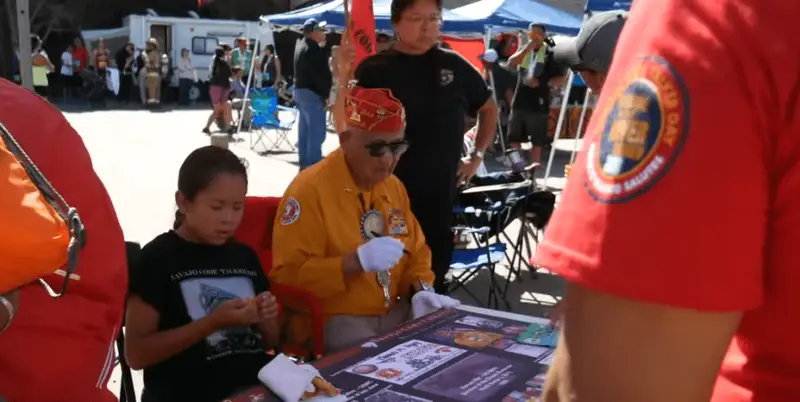
The goal of the current wave of revitalization initiatives is to address the issue before adult remediation becomes necessary. Saad K’idilyé is the first Diné language immersion program at the university level that focuses on cultural revitalization rather than just language instruction. It was started at the University of New Mexico and is scheduled to expand in August 2026. Language nests, immersion preschools, and community-run after-school programs are examples of early childhood programs that aim to reach kids at the ages when language acquisition occurs most naturally. The goal is to establish a setting where Diné Bizaad serves as both the medium and the subject, allowing kids to learn science, math, and storytelling in Navajo, just as earlier generations did before anyone decided to stop them.
It is truly difficult to estimate the amount of time. Navajo is classified by UNESCO as “vulnerable” rather than “critically endangered,” which may seem reassuring, but it isn’t given that the population that speaks the language fluently is aging and that transmission to children has been disrupted for two or three generations. The language itself is incredibly complicated; it is verb-heavy, tonal, has grammatical structures that are unmatched in English, and its vocabulary creates new words by fusing existing roots rather than borrowing. “Thinking metal” replaces “computer.” Because it exists in speakers’ minds rather than in dictionaries, that type of organic linguistic creativity is both lovely and delicate.
Observing this endeavor from the outside gives the impression that the Navajo Nation is fighting against something much bigger than itself: the same forces of assimilation and globalization that have wiped out hundreds of languages in the American West and around the globe. According to a linguist, a language is lost on Earth every two weeks. The majority of those losses occur in silence, with no emergency being declared. At least one is being declared by the Navajo Nation. No one in Window Rock can yet confidently respond to the question of whether the emergency response arrives in time.
London Bilingualism's content on health, medicine, and weight loss is solely meant for general educational and informational purposes. This website does not offer any diagnosis, treatment recommendations, or medical advice.
We consistently compile and disseminate the most recent information, findings, and advancements from the medical, health, and weight loss sectors. When content contains opinions, commentary, or viewpoints from professionals, industry leaders, or other people, it is published exactly as it is and reflects those people's opinions rather than London Bilingualism's editorial stance.
We strongly advise all readers to consult a qualified medical professional before acting on any medical, health, dietary, or pharmaceutical information found on this website. Since every person's health situation is different, only a qualified healthcare provider who is familiar with your medical history can offer you advice that is suitable for you.
In a similar vein, any legal, regulatory, or compliance-related information found on this platform is provided solely for informational purposes and should not be used without first obtaining independent legal counsel from a licensed attorney.
You understand and agree that London Bilingualism, its editors, contributors, and affiliated parties are not responsible for any decisions made using the information on this website.
