

A certain type of school doesn’t make a big announcement about itself. Not a billboard. There was no eye-catching postcard about an open house in the mailbox. Nestled in Bellevue, Washington’s Crossroads neighborhood, Bel-Red Bilingual Academy occupies a 6,000-square-foot building with air-conditioned classrooms and a shuttle bus in front. Its address is 15061 Bel-Red Road. Driving past it is simple. Once inside, it’s more difficult to forget.
The school operates between a full immersion language program and a Montessori philosophy, which sounds ambitious—possibly even overstuffed—until you see it in action. Toddlers as young as 15 months are navigating learning centers—Practical Life, Sensorial, Language, Mathematics, Science, and Art—in an environment designed to pique their curiosity rather than in rows of desks. The items on the shelves are not haphazard. They are selected to develop their motor and cognitive abilities in the same afternoon that a three-year-old is, in some way, learning Mandarin.
In contrast to most private schools in the Pacific Northwest, where a second language, if offered at all, typically arrives around third grade, well past the window that researchers generally consider ideal, Bel-Red takes a bilingual approach, using both English and Chinese. In linguistics, there is a long-standing debate about the precise moment when the window closes, but the majority of the evidence points to earlier being significantly better. The entire structure of the school seems to have been constructed around that idea. Even in the toddler program, Spanish classes are held twice a week. Songs, colors, animal names, and numbers are all part of the low-stakes repetition that, according to research on early language acquisition, does something subtle and long-lasting to a child’s brain. It’s difficult to deny that the families who discovered this location early on feel as though they have discovered something that the larger market hasn’t yet fully embraced.
The kids have set aside time outside to run, climb, play in the sandbox, and simply be unstructured. It may seem apparent, but outdoor time is often neglected in early education programs. Since social learning and motor development don’t only occur at a table, it is purposefully incorporated into the daily routine. Additionally, there is a weekly music class that covers instruments, rhythm, pitch, and tempo. This type of program is rarely able to withstand budget cuts at larger institutions, but it is still affordable for smaller schools like this one.
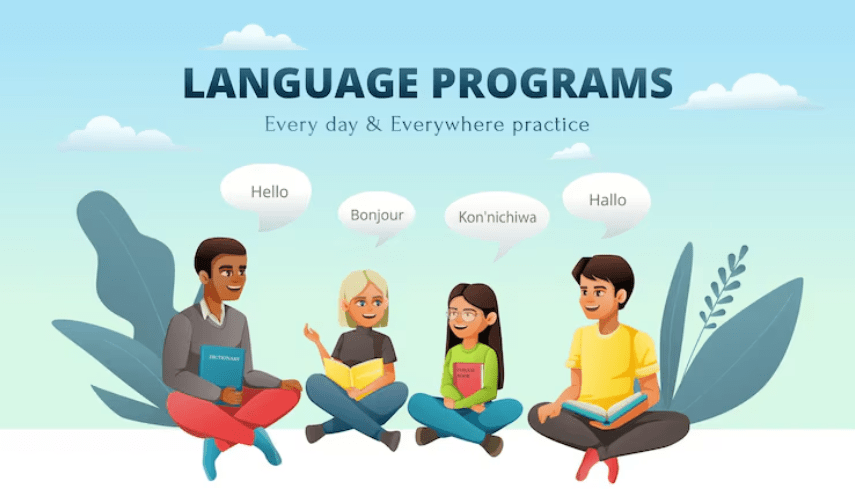
There are about 108 students enrolled, and the student-to-teacher ratio is about 8 to 1. Sometimes people don’t realize how important that number is. In an eight-person classroom, a teacher can truly see when a student is struggling, inquisitive, or quietly ahead of the curriculum’s expectations. Although the school notes that the majority of its first and second graders who test into public school gifted programs do so after leaving, it’s still unclear whether small class sizes alone produce the academic results Bel-Red points to. At the very least, the environment doesn’t impede that outcome.
The school’s drop-in program, which operates with sessions capped at ten students, up to four hours at a time, and costs $39 per day, adds another dimension to its offerings for students aged five to twelve. For families who want access to a supervised, structured, bilingual environment on their own schedule but do not require full-time enrollment, this model is surprisingly flexible. The Brightwheel app is used for scheduling, and open houses are held every week in the evenings. These details indicate that the school is considering working parents’ lives in addition to the ideal of education.
Bel-Red holds certification from the Washington State Board of Education and accreditation from the Northwest Association of Accredited Schools. These qualifications are important, but what the families who have stayed seem to value more is something more difficult to verify: a feeling that the school was founded on a genuine belief about how kids learn best rather than on what was most marketable. It’s still too early to say for sure whether that will be sufficient to maintain a small private school’s success in an increasingly competitive education market. However, there is a shuttle bus that runs every morning, the classrooms are full, and the kids are learning in two languages prior to kindergarten. That is not insignificant.
London Bilingualism's content on health, medicine, and weight loss is solely meant for general educational and informational purposes. This website does not offer any diagnosis, treatment recommendations, or medical advice.
We consistently compile and disseminate the most recent information, findings, and advancements from the medical, health, and weight loss sectors. When content contains opinions, commentary, or viewpoints from professionals, industry leaders, or other people, it is published exactly as it is and reflects those people's opinions rather than London Bilingualism's editorial stance.
We strongly advise all readers to consult a qualified medical professional before acting on any medical, health, dietary, or pharmaceutical information found on this website. Since every person's health situation is different, only a qualified healthcare provider who is familiar with your medical history can offer you advice that is suitable for you.
In a similar vein, any legal, regulatory, or compliance-related information found on this platform is provided solely for informational purposes and should not be used without first obtaining independent legal counsel from a licensed attorney.
You understand and agree that London Bilingualism, its editors, contributors, and affiliated parties are not responsible for any decisions made using the information on this website.
