

One of the driest regions on Earth is the northern Chilean Atacama Desert. It receives less than one millimeter of rain annually in some areas. In a trial run a few years ago, a cookie-sheet-sized hydrogel panel placed out there overnight filled with moisture and released it as drinkable water the following day. This is the kind of landscape where everything seems to argue against the presence of water. The experiment was successful. Then the substance began to crumble. Water scientists and climate researchers are paying close attention to a new paper from Stanford and MIT that details this issue and the four-year effort to solve it.
The hydrogel is not a novel substance in and of itself. It is composed of polyacrylamide, the same polymer used in diapers, and lithium chloride, a superabsorbent salt. The gel swells at night as the salt absorbs water vapor from the surrounding air. During the day, heat from the sun is absorbed by a black-painted metal sheet underneath, warming the hydrogel until the trapped vapor is released. After condensing into liquid water, that vapor is gathered. Sunlight is the only source of power for the system. No fan, no battery, and no grid. The substance demonstrated the ability to retain two to four times its own weight in water in the Atacama, even under circumstances that most other technologies are unable to.
Durability was the catch. In preliminary experiments, the hydrogel broke down after about thirty fill-and-release cycles. That is insufficient to make the technology commercially feasible, and it poses a safety risk because fragments of the degraded polymer may seep into the collected water, contaminating what ought to be a pure product. According to Carlos Diaz-Marin, co-lead author of the new study and assistant professor at Stanford’s Doerr School of Sustainability, any deterioration renders the water unfit for human consumption. That is the kind of issue that prevents a technology from being used by those who most need it.
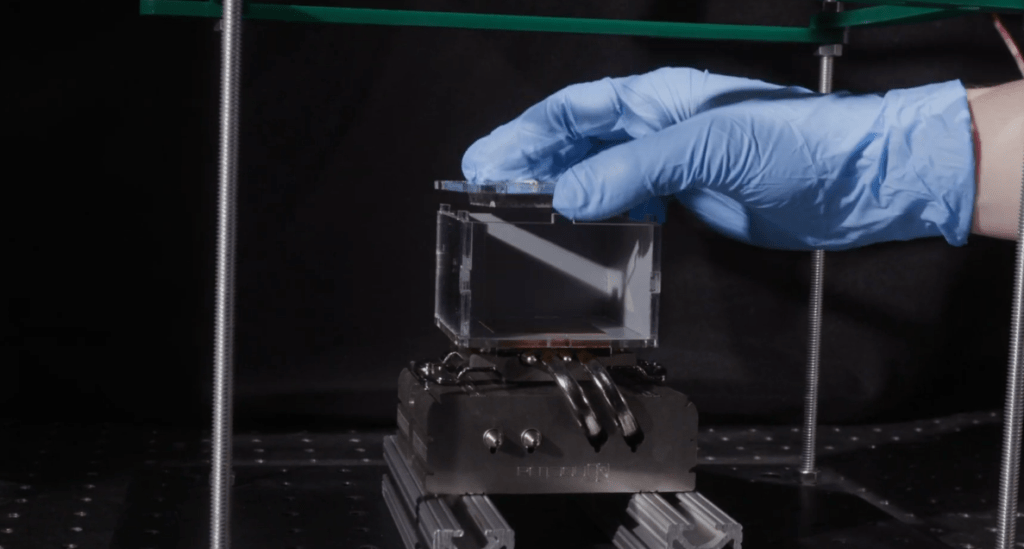
Over the course of four years of laboratory work, Diaz-Marin and his colleagues—including graduate student Chad Wilson from MIT—discovered that the hydrogel itself was not the problem, but rather the surface it was resting on. Free radicals were produced inside the gel by the ions released by the metal substrate, which was required to conduct solar heat into the material. The material turned to goo as a result of those radicals attacking the polymer chains. Diaz-Marin noted that the radicals are highly effective at consuming the polymer. Applying a commercial anti-corrosion coating to the metal surface proved to be the solution. The hydrogel’s lifespan was significantly increased by that one modification. The coated material remained stable for over eight months and underwent over 190 harvesting cycles without deterioration in stress tests conducted at 167 degrees Fahrenheit.
It is especially significant to witness this type of incremental materials science yield a result that might actually matter on a global scale. Currently, over two billion people do not have access to clean drinking water. More than 46 million people experience water insecurity in the United States alone. With the durability improvements now attained, the researchers predict that the system could eventually produce water at about one cent per liter, which is about one percent of the price of bottled water and comparable to what American households pay for tap water from a municipal system. “We see a path to this technology to perhaps even being competitive with tap water,” Diaz-Marin stated.
In an emergency, the current design can generate up to two liters of water per panel per day, which is roughly what a person needs for basic health. That’s encouraging, but Diaz-Marin’s goal is five liters, which is sufficient for everyday household use in arid areas where piped infrastructure and desalination are impractical. A window-sized panel tested in Death Valley, California, produced between 57 and 161 milliliters per day even at humidity levels as low as 21 percent, demonstrating how MIT’s parallel research has pushed toward larger formats. Although the MIT device employs a different structural strategy—an origami-inspired dome pattern that increases surface area—the underlying chemistry is very similar to the Stanford work.
It is still too soon to declare this issue resolved. There are still unanswered questions about scale, manufacturing costs, and practical implementation in the communities most in need. However, the durability issue that was silently killing this class of technology has now been found and fixed in a paper that can be expanded upon by other researchers. That is not insignificant. In five years, a family in rural Chile or inland sub-Saharan Africa might be drinking water drawn from the atmosphere by a solar panel mounted on their roof. It’s still a long way from a Death Valley test to that point. However, this month it became noticeably shorter.
London Bilingualism's content on health, medicine, and weight loss is solely meant for general educational and informational purposes. This website does not offer any diagnosis, treatment recommendations, or medical advice.
We consistently compile and disseminate the most recent information, findings, and advancements from the medical, health, and weight loss sectors. When content contains opinions, commentary, or viewpoints from professionals, industry leaders, or other people, it is published exactly as it is and reflects those people's opinions rather than London Bilingualism's editorial stance.
We strongly advise all readers to consult a qualified medical professional before acting on any medical, health, dietary, or pharmaceutical information found on this website. Since every person's health situation is different, only a qualified healthcare provider who is familiar with your medical history can offer you advice that is suitable for you.
In a similar vein, any legal, regulatory, or compliance-related information found on this platform is provided solely for informational purposes and should not be used without first obtaining independent legal counsel from a licensed attorney.
You understand and agree that London Bilingualism, its editors, contributors, and affiliated parties are not responsible for any decisions made using the information on this website.
