

The kids aren’t sitting at tables studying vocabulary lists on a Tuesday morning in a regular bilingual academy preschool classroom. In a corner with building blocks, a group of four-year-olds are arguing over whose turn it is. The instructor is watching the fight, but she doesn’t step in right away. The disagreement is taking place in both Spanish and English. A youngster is going through a sorting exercise near the Montessori material shelves, transferring items from one tray to another with the concentrated focus that three-year-olds occasionally exhibit and adults frequently underestimate.
There is a moderate amount of noise. The task is dispersed. No one is waiting to be instructed on what to do next. In reality, a play-based multilingual learning environment looks like this: it is significantly less structured than a regular classroom, yet it is significantly more successful by most developmental metrics.
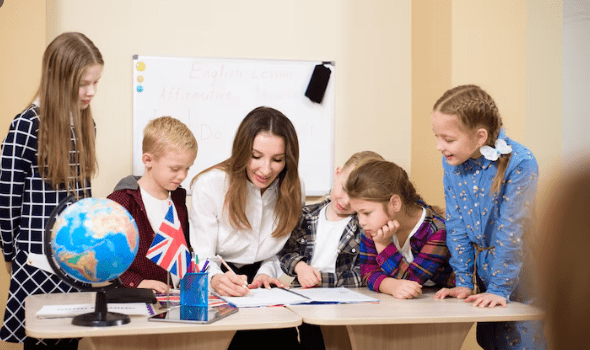
Instead than following a set academic order, the Early Learning Bilingual Academy (ELBA) approach bases its curriculum on children’s shown interests. The Spanish-English curriculum is taught throughout the day, with social skills like sharing, taking turns, and resolving conflicts being taught and practiced in both languages at the same time. It is not a foreign language class tacked on to an otherwise traditional preschool.
The logic is developmental rather than promotional: kids who can communicate in two languages when they’re angry, happy, or unsure have more tools for self-control than kids who can only speak one. Research has repeatedly shown that self-regulation is one of the best indicators of kindergarten preparedness; in certain cases, it is even more accurate than pre-literacy measures. The model’s goal is to get there through play and peer interaction rather than worksheets and correction.
A set of ideas that Maria Montessori created more than a century ago and that the educational research community has spent decades validating and improving are the source of the Montessori influence in ELBA’s methodology. Children who have the freedom and initiative to choose what to interact with learn more effectively than those who only receive information passively. When children are given the freedom to make mistakes and learn from them instead of having adults correct them before they happen, autonomy and self-regulation develop more consistently.
The setting is crucial: a room set up around teacher delivery yields different results than one filled with objects that encourage real curiosity. Montessori’s statement that “the first task of education is to shake life, but leaving it free to develop” is a somewhat poetic way of framing an observation that has since been validated in much more clinical language by child developmental research. The goal of ELBA’s classroom design is to put that idea into practice in a multilingual setting.
Preschool bilingual education has such a strong cognitive justification that campaigning is hardly necessary anymore. Bilingual kids outperformed their monolingual peers in memory, problem-solving, and executive function, according to a 2017 Cambridge English study. Multilingual learning environments have been associated with improved social competence, according to a 2023 Frontiers in Education study.
The advantages go beyond the extra language; they also include general cognitive flexibility, which is the capacity to switch between conflicting demands and viewpoints and shows up in social interaction, reading comprehension, and arithmetic. Whether bilingual preschool is effective is not the question. The concern is whether a particular program has the staffing, curriculum design, and classroom culture necessary to deliver it consistently; this is addressed program by program rather than in a general way.
It seems that the most successful early education is the one that resembles a classroom the least, based on how children navigate these settings: switching between languages, negotiating with peers, choosing which activity to pursue, learning to correct their own work instead of waiting for an adult to mark it incorrectly.
With its Spanish curriculum foundation, Montessori framework, and emphasis on play as a means of fostering social and linguistic growth, the ELBA model aims to develop in kids the ability to engage with learning as something they’re doing rather than something being done to them before they enter kindergarten. The broader question is whether such capacity will continue in the years to come. It does, according to the preliminary data, which is consistent across various programs and research settings.
London Bilingualism's content on health, medicine, and weight loss is solely meant for general educational and informational purposes. This website does not offer any diagnosis, treatment recommendations, or medical advice.
We consistently compile and disseminate the most recent information, findings, and advancements from the medical, health, and weight loss sectors. When content contains opinions, commentary, or viewpoints from professionals, industry leaders, or other people, it is published exactly as it is and reflects those people's opinions rather than London Bilingualism's editorial stance.
We strongly advise all readers to consult a qualified medical professional before acting on any medical, health, dietary, or pharmaceutical information found on this website. Since every person's health situation is different, only a qualified healthcare provider who is familiar with your medical history can offer you advice that is suitable for you.
In a similar vein, any legal, regulatory, or compliance-related information found on this platform is provided solely for informational purposes and should not be used without first obtaining independent legal counsel from a licensed attorney.
You understand and agree that London Bilingualism, its editors, contributors, and affiliated parties are not responsible for any decisions made using the information on this website.
