

A man by the name of Pancho lived in a sort of locked room for almost twenty years. At the age of 20, he suffered a stroke in the early 2000s that nearly completely destroyed his ability to move, speak, and carry on a normal conversation. He was able to groan. He was able to grunt. However, the words remained stuck behind his eyes, only audible to him.
Inside a lab at the University of California, San Francisco, that gradually and intermittently changed. Then, in May of last year, it was altered once more, this time in two languages.
A neuroprosthesis that sits on the surface of Pancho’s brain, listening to the electrical chatter of his motor cortex and translating the intended movements of his vocal tract into actual words on a screen, is what the team led by neurosurgeon Dr. Edward Chang of UCSF’s Center for Neural Engineering and Prostheses has been working on for years. It sounds like science fiction, but it’s becoming less and less. His English was restored with the first significant breakthrough, which was published in 2021. The more recent study took a more difficult approach and was published in Nature Biomedical Engineering on May 20. It taught the same implant to alternate between English, which Pancho learned as an adult, and Spanish, which was his native tongue and the language he dreamed of growing up.
People frequently cite a 75% accuracy rate. This is the speed at which Pancho’s attempted sentences were correctly decoded by the AI model that was trained on his brain activity using PyTorch and NVIDIA V100 GPUs. It’s not flawless. The speed at which a healthy speaker speaks is far faster. However, reading the paper gives me the impression that the number understates what’s going on in that room. The team simply sat there for a few minutes, grinning, following one early successful sentence, Alexander Silva, the lead author, told Nature. It’s difficult not to imagine that scene: the screen glowing with words that, until recently, only existed in someone’s head, and the quiet hum of equipment.
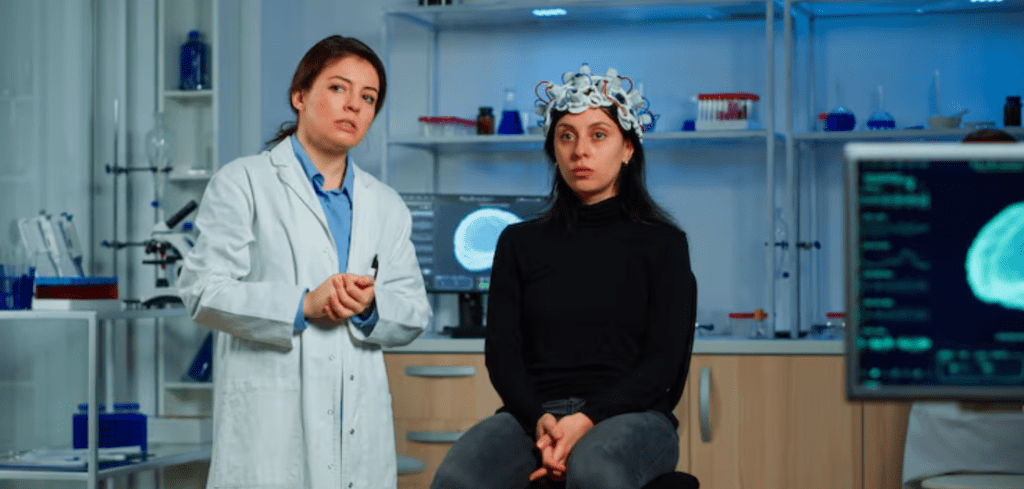
What the research indicates about the bilingual brain is intriguing and somewhat unsettling from a philosophical standpoint. The assumption that different languages reside in different neural neighborhoods was prevalent in earlier neuroscience textbooks. Pancho’s performance regresses. His English and Spanish seem to come from the same area of the brain, which is in charge of articulating words regardless of the language they belong to. This overlap was crucial to the researchers. They employed transfer learning, which is similar to how people actually learn a second language, by using information from one language to speed up decoding in the other.
All of this has a practical benefit as well. The majority of current communication tools for individuals with severe paralysis, such as touchscreen keyboards and eye-tracking systems, are slow, tiresome, and culturally irrelevant, and about half of the world’s population speaks more than one language. A gadget that can translate between Spanish and English according to Pancho’s true intentions is more in line with the way bilingual people actually live. Individuals don’t sit down and decide on a language. Sometimes in the middle of a sentence, they stray between them.
How quickly any of this reaches patients outside of a research setting is still unknown. Although one case isn’t a clinical trial, the implant has been in Pancho’s head since February 2019, which suggests something encouraging about durability. Brain-computer interface regulations are still costly, time-consuming, and politically complex. Neuralink and other labs are pursuing related issues with quite different approaches.
Even so. It’s difficult not to sense that something truly novel is on the table as you watch this play out. Not a remedy. Not a religious miracle. At last, a man, a chip, and an AI were able to hear him in both of his languages.
London Bilingualism's content on health, medicine, and weight loss is solely meant for general educational and informational purposes. This website does not offer any diagnosis, treatment recommendations, or medical advice.
We consistently compile and disseminate the most recent information, findings, and advancements from the medical, health, and weight loss sectors. When content contains opinions, commentary, or viewpoints from professionals, industry leaders, or other people, it is published exactly as it is and reflects those people's opinions rather than London Bilingualism's editorial stance.
We strongly advise all readers to consult a qualified medical professional before acting on any medical, health, dietary, or pharmaceutical information found on this website. Since every person's health situation is different, only a qualified healthcare provider who is familiar with your medical history can offer you advice that is suitable for you.
In a similar vein, any legal, regulatory, or compliance-related information found on this platform is provided solely for informational purposes and should not be used without first obtaining independent legal counsel from a licensed attorney.
You understand and agree that London Bilingualism, its editors, contributors, and affiliated parties are not responsible for any decisions made using the information on this website.
