

The first time a researcher puts an EEG cap on a bilingual participant while a high-speed eye-tracker hums softly on the desk is a brief, almost theatrical moment in any psycholinguistics lab. The electrodes contain gel. On the monitor, a calibration grid is blinking.
The participant is attempting to avoid blinking. As this develops, it is difficult to ignore the fact that scientists’ choices about how to investigate language have changed. The two machines were operated by different people, lived in separate rooms, and asked different questions for decades. The bilingual mind, which has long been studied through deft but indirect tests, is now being examined from two perspectives simultaneously as they sit side by side.
| Field | Detail |
|---|---|
| Methodology | Simultaneous recording of EEG and eye-tracking signals during natural language tasks |
| Primary Use | Bilingual language processing, vocabulary learning, reading comprehension |
| Temporal Resolution | Millisecond-level (EEG) paired with gaze duration in real time |
| Key Researchers Cited | Dimigen et al. (2011), Godfroid (2020), Kutas & Federmeier (2011), Pellicer-Sánchez et al. (2020) |
| Core Measures | First fixation duration, regression path, ERPs (notably the N400 component) |
| Main Application Areas | Crosslinguistic activation, inference revision, incidental vocabulary acquisition |
| Why It Matters | Captures cognitive processing that behavioral tests miss entirely |
| Methodological Status | Common in monolingual reading studies; still rare in bilingualism research |
| Typical Equipment | High-speed eye-tracker (250–1000 Hz) synced with 32 or 64-channel EEG cap |
| Known Challenges | Eye-movement artifacts in EEG signal, time-locking analysis, participant fatigue |
Even though the execution is difficult, the logic is straightforward. Eye tracking reveals the location and duration of attention. EEG displays the electrical activity of the brain in real time. You get half a story when you run them separately. When combined, the dataset grows beyond the sum of its components. Finally, researchers can see the precise location of a bilingual reader’s hesitation and the neural response that occurred at that precise moment. Now it sounds clear. It was technically impossible for a very long time.
Behavioral studies on bilingualism, such as picture naming, language switching, and priming tasks, yielded useful but direct response times and accuracy rates. They told you where a thought was going, not how it got there. By revealing the tiny reading hesitations—a regression, a prolonged fixation, or a saccade gone slightly wrong—eye-tracking advanced the process.
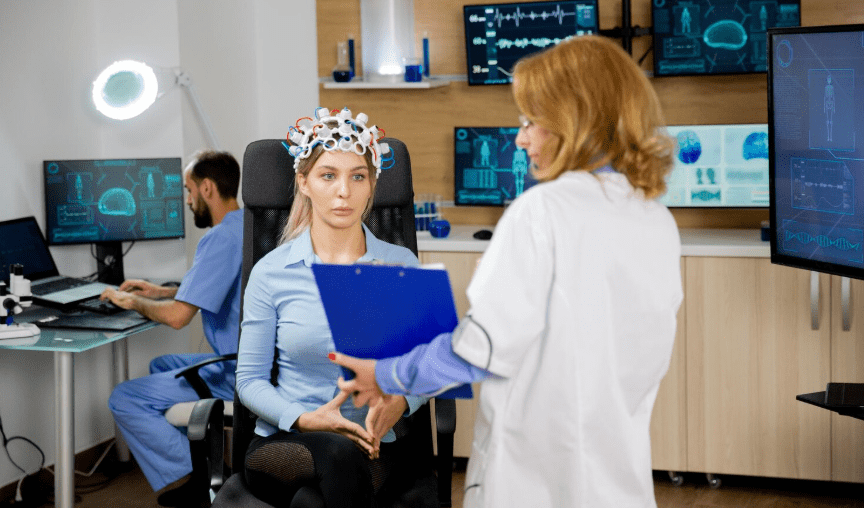
Event-related potentials, which indicate the exact times the brain registered surprise, conflict, or recognition, added another layer to the EEG. By itself, each technique advanced the field. The same question was also left unanswered by each.
That gap is filled by co-registration, a term that researchers now use almost casually. It has been gaining traction in monolingual studies for more than ten years. It is the simultaneous recording of eye movements and brain activity during natural reading or scene viewing. Given how much the field has to gain, it is interesting that bilingual research has been slower to catch up. The way two languages remain active in the mind even when only one is being used is known as crosslinguistic activation, and it is precisely the kind of process that happens too quickly and too subtly for behavioral measures to record. Researchers believe that co-registration may at last reveal what is going on in those overlapping milliseconds.
Another area where the approach seems almost overdue is vocabulary learning. Reading studies have consistently demonstrated that a learner’s ability to recall the meaning of an unfamiliar word is predicted by the amount of time they spend looking at it. However, long before the eyes show any indication of the word, the brain may register its shape, sound, or sense. That early flicker can be detected by EEG. When combined with gaze data, it provides a much more accurate picture of how new words are actually assimilated during reading rather than in a lab exercise centered around them.
Of course, the difficulties are real. EEG signals are contaminated by electrical artifacts caused by eye movements. Careful design is needed to time-lock the two data streams. Bilinguals who are tested in their weaker language experience fatigue more quickly than other participants. Whether every research question gains from the increased complexity is still up for debate. However, the direction of travel seems certain. Slowly but clearly, the field is moving toward understanding bilingual minds as they truly function—not one signal at a time, but all at once, like the violins and percussion finally playing in the same room.
London Bilingualism's content on health, medicine, and weight loss is solely meant for general educational and informational purposes. This website does not offer any diagnosis, treatment recommendations, or medical advice.
We consistently compile and disseminate the most recent information, findings, and advancements from the medical, health, and weight loss sectors. When content contains opinions, commentary, or viewpoints from professionals, industry leaders, or other people, it is published exactly as it is and reflects those people's opinions rather than London Bilingualism's editorial stance.
We strongly advise all readers to consult a qualified medical professional before acting on any medical, health, dietary, or pharmaceutical information found on this website. Since every person's health situation is different, only a qualified healthcare provider who is familiar with your medical history can offer you advice that is suitable for you.
In a similar vein, any legal, regulatory, or compliance-related information found on this platform is provided solely for informational purposes and should not be used without first obtaining independent legal counsel from a licensed attorney.
You understand and agree that London Bilingualism, its editors, contributors, and affiliated parties are not responsible for any decisions made using the information on this website.
