

Witnessing a child fall in love with a piece of plastic and software is a little strange. There is not much movement in the toy. It blinks. It talks. The child then begins to treat it more like a small companion who happens to know things, rather than like a gadget, at some point between the second and third interaction. That’s essentially the strange territory that ROYBI Robot has ventured into, and based on the feedback thus far, it’s a territory that more parents are willing to explore than anyone could have predicted even five years ago.
Elnaz Sarraf, the company’s founder and CEO, created ROYBI, a tiny egg-shaped gadget that is being referred to as the first bilingual AI-powered smart toy created especially for early childhood education. In addition to teaching languages—mostly English and Mandarin at first—it also teaches a growing number of STEM subjects through games, stories, and brief conversations. The idea seems straightforward. Less so was the execution. In some ways, creating a robot that can captivate a four-year-old is more difficult than creating one that can operate a vehicle. Children are harsh critics.
The surprising thing about the company’s beginnings is how unglamorous it was. About four and a half years ago, Sarraf started the project by working with one other person, sketching ideas on paper in her bedroom, and bootstrapping for about a year and a half. She has publicly discussed running out of money multiple times, receiving over 200 rejections from investors, and leaving meetings when people asked her how she intended to prevent the company from failing rather than how she intended to expand it. It’s difficult to ignore the trend in those tales: women are typically the ones who create things that others find difficult to comprehend.
After she eventually raised $4.2 million from Silicon Valley angel investors in a 2019 seed round, ROYBI subtly started making appearances in significant locations. It was listed twice by TIME Magazine as one of the greatest educational innovations. It was named one of the most promising startups to watch by CNBC. The company is a game-changer for kids, according to Forbes. When the momentum did come, it came all at once.
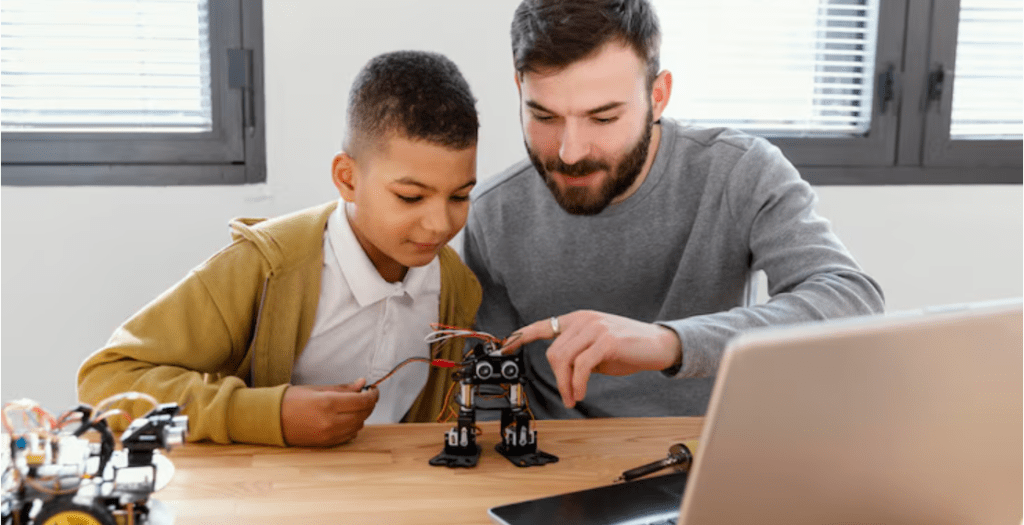
The more significant issue that looms over all of this isn’t actually related to ROYBI. It concerns whether or not parents and educational institutions are prepared to allow robots into a child’s formative years. Artificial intelligence is still viewed with suspicion in classrooms, and for good reason. Sarraf has maintained that more needs to be done by governments, educational institutions, and tech companies to demystify the true functions and limitations of these systems. According to her, AI won’t take the place of parents or teachers. It’s bridging a gap, especially in areas where local access to high-quality early education is lacking. Over 250 million children worldwide are thought to have unrealized potential by the time they turn five. Sitting with that number is worthwhile.
It remains to be seen if a small bilingual robot can effectively bridge that gap. In edtech, the term “personalized learning” is used haphazardly, and not all products meet its standards. However, ROYBI’s strategy, which uses machine learning and data to tailor lessons to each child’s interests instead of providing the same lessons to every user, at least suggests something more considerate than the typical app-based fare.
You get the impression that the harder work is just getting started as you watch the company expand, with offices now located in China and California. Technology is advancing. It appears that investors have faith in the long-term plan. Parents seem interested and occasionally excited. A child is currently laughing at a robot that just told her a story in two languages in a living room. At least that part feels authentic.
London Bilingualism's content on health, medicine, and weight loss is solely meant for general educational and informational purposes. This website does not offer any diagnosis, treatment recommendations, or medical advice.
We consistently compile and disseminate the most recent information, findings, and advancements from the medical, health, and weight loss sectors. When content contains opinions, commentary, or viewpoints from professionals, industry leaders, or other people, it is published exactly as it is and reflects those people's opinions rather than London Bilingualism's editorial stance.
We strongly advise all readers to consult a qualified medical professional before acting on any medical, health, dietary, or pharmaceutical information found on this website. Since every person's health situation is different, only a qualified healthcare provider who is familiar with your medical history can offer you advice that is suitable for you.
In a similar vein, any legal, regulatory, or compliance-related information found on this platform is provided solely for informational purposes and should not be used without first obtaining independent legal counsel from a licensed attorney.
You understand and agree that London Bilingualism, its editors, contributors, and affiliated parties are not responsible for any decisions made using the information on this website.
