

Anyone who has spent time with bilingual kids will recognize the moment when the tiny machinery of their thinking emerges. In a Karachi kitchen, a four-year-old asks for water after tilting her head, thinking about her grandmother for a brief moment, and switching from English to Urdu. She was not taught that. She scanned the space. She made a choice regarding the thoughts of another person. She then took action on it almost carelessly.
For years, scholars have been debating whether or not this type of moment has the significance that it appears to have. The question is whether children who grow up switching between two languages also become more adept at switching between viewpoints; that is, whether the day-to-day mechanics of bilingual life subtly develop what is commonly referred to as theory of mind, which is the awareness that others have their own ideas, opinions, and knowledge gaps.
| Field | Detail |
|---|---|
| Topic | Bilingualism and Theory of Mind in Children |
| Core Concept | Theory of Mind — understanding that others hold beliefs, intentions, and perspectives distinct from one’s own |
| Population Studied | Children aged roughly 3–7, with comparisons extending into adulthood |
| Key Cognitive Skill | Perspective-taking, false-belief understanding, code-switching awareness |
| Notable Researchers | Ellen Bialystok, Paula Rubio-Fernández, Boaz Keysar |
| Associated Brain Regions | Prefrontal cortex, anterior cingulate, areas linked to executive function and attention control |
| Common Test Used | Sally-Anne task, false-belief tasks, director task |
| Age of Early Advantage | As early as age 3, before full literacy develops |
| Reported Adult Carryover | Improved social cue reading, cultural fluency, empathy in multilingual environments |
| Public Interest Angle | Parenting, education policy, immigration, identity, classroom design |
| Debate Status | Active — effect sizes vary, replication ongoing, not universally accepted |
| Practical Relevance | Schools, speech therapists, immigrant families, multilingual households |
If not conclusive, the evidence is suggestive. Bilingual preschoolers typically do better on false-belief tasks, which are tiny experimental setups used to determine whether a child understands that someone else may hold a mistaken view of the world, according to studies dating back almost 20 years. Admittedly, it’s a limited measure. However, it continues to appear. On average, bilingual kids appear to understand earlier that their knowledge is not always shared by others.
The explanation might be easier than it seems. A bilingual child is always keeping track of which language each person speaks. The teacher speaks English, the grandfather speaks Punjabi, and the visiting cousin from Toronto speaks a mix depending on the situation. That tracking is basically perspective-taking in disguise; it is light, almost invisible, and done dozens of times a day. The child is keeping an eye on what the other person can comprehend and making adjustments. When you slow it down, empathy is not too far from that.
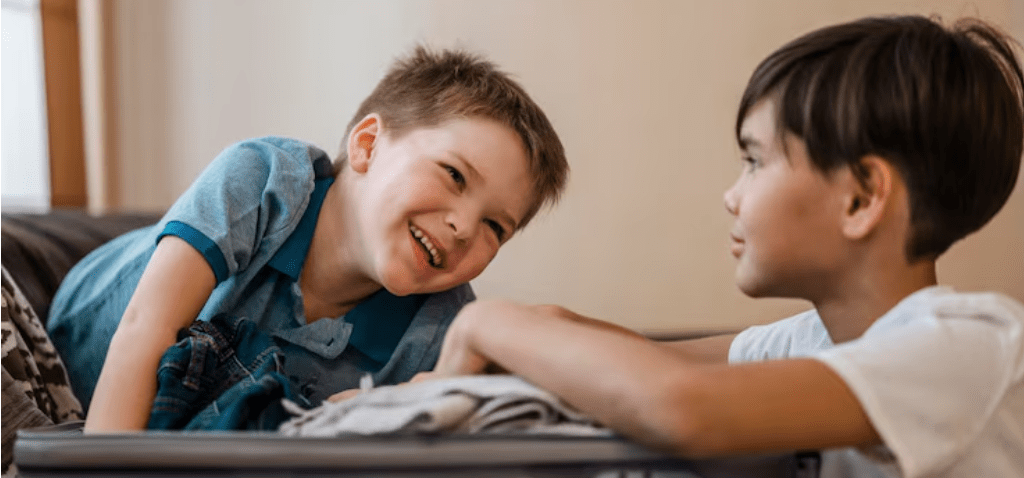
However, there is disagreement in the research, as anyone who closely examines the literature will see. Strong effects are found in some studies, but only in certain tasks, when income and education are taken into consideration, or when the child uses the two languages with genuinely different people. There’s a feeling that the effect is genuine but conditional, that living bilingualism rather than just studying it makes the perspective-taking advantage most evident. A child who attends a language enrichment class twice a week is not the same as a child who is raised in two different cultures.
As you watch this play out, it’s difficult to ignore how quickly the discussion turns into something more. Children’s bilingualism affects nearly every contentious issue in contemporary parenting, including identity, education, migration, screen time, and the importance of grandparents. A second language is fiercely guarded by some families. Some let it wander. Nobody is really told what to do with that by cognitive science. It merely subtly implies that something intriguing might be going on beneath the surface, and that the kids juggling two worlds might be subtly developing the ability to imagine other people’s minds with a fluency that the rest of us have to strive for.
It’s still unclear if that translates into true empathy, which is the deep, emotional kind rather than just the ability to follow another person’s perspective. A child who reads the room well is not necessarily a kinder one, and cognitive perspective-taking and emotional warmth are not the same thing. However, if the preliminary results are correct, there is a real overlap and significant ramifications. The kids who are already doing it might be learning something that the rest of us never fully grasped in a world where more and more people are asked to switch between cultures, languages, and ways of belonging.
London Bilingualism's content on health, medicine, and weight loss is solely meant for general educational and informational purposes. This website does not offer any diagnosis, treatment recommendations, or medical advice.
We consistently compile and disseminate the most recent information, findings, and advancements from the medical, health, and weight loss sectors. When content contains opinions, commentary, or viewpoints from professionals, industry leaders, or other people, it is published exactly as it is and reflects those people's opinions rather than London Bilingualism's editorial stance.
We strongly advise all readers to consult a qualified medical professional before acting on any medical, health, dietary, or pharmaceutical information found on this website. Since every person's health situation is different, only a qualified healthcare provider who is familiar with your medical history can offer you advice that is suitable for you.
In a similar vein, any legal, regulatory, or compliance-related information found on this platform is provided solely for informational purposes and should not be used without first obtaining independent legal counsel from a licensed attorney.
You understand and agree that London Bilingualism, its editors, contributors, and affiliated parties are not responsible for any decisions made using the information on this website.
