On a Tuesday afternoon, stand in any supermarket line in Peckham, Southall, or Hackney, and you will be surrounded by an amazing sound. Not very loud. Not disorderly. Just layered — phrases that resolve into Somali, then Gujarati, then something that might be Tigrinya or Amharic, then the particular London English of someone who grew up speaking both languages and now speaks neither quite as their parents did. It is quite commonplace. No one says anything about it. In a sense, that’s what makes it so amazing.
For longer than most of its citizens realize, London has been the world’s most linguistically diverse city.
The most often quoted number, 300 languages spoken regularly within the city limits, comes from a 1993 study by the University of London’s School of Oriental and African Studies, which counted 275. Subsequent research brought the figure closer to 300, and the revision was an improvement in measuring what had always existed rather than an increase in diversity. One of the most eminent phoneticians in Britain, Professor John Wells of University College London, observed at the time that the figure was more of an acknowledgement of something that had been quietly and steadily developing for generations than a statement about London’s recent transformation.
| City | London, United Kingdom |
|---|---|
| Languages Spoken | Over 300 languages spoken regularly within the city boundaries |
| Designation | Most linguistically diverse city in the world; most cosmopolitan city in Europe |
| Original Research | University of London’s School of Oriental and African Studies (SOAS), 1993 — 275 languages identified |
| Updated Figure | Closer to 300 (reported by The Independent, 1999; confirmed by subsequent monitoring improvements) |
| Source — City of Languages | London City of Languages initiative (londoncityoflanguages.org.uk) — “One city. 300+ languages. Endless possibilities.” |
| GLA Language Support | Greater London Authority supports Londoners attending language, literature, and culture courses — 2,530 participants noted |
| Key Academic | Professor John Wells, Professor of Phonetics, University College London |
| Business Case | Air France relocated nine European telephone reservation centres to Wembley, creating 200+ jobs; reason: multilingual workforce |
| Centre Manager — Air France | Frederic Verdier |
| Other Companies Referenced | Delta Airlines, TWA — preferred London as pan-European call centre hub |
| Ethnic Communities | 33 communities of 10,000+ people born outside England; 12 further communities of 5,000+ |
| Notable Concentrations | Japanese community: Totteridge and Finchley; Hong Kong community: Barnet |
| Irish Community | 200,000+ born in Ireland — largest single overseas-born community |
| Mauritian Community | ~14,000 |
| Restaurant Count | 7,000+ restaurants in London (nearly 25% of all UK restaurants) |
| Indian Restaurants | More Indian restaurants in London than in Mumbai |
| Spectator Coverage | “The hundreds of languages spoken in London are the city’s greatest glory” (February 2020) |
| Source — London Research Centre | Marian Storkey, Principal Officer — noted community spread differs from New York’s concentrated ethnic geography |
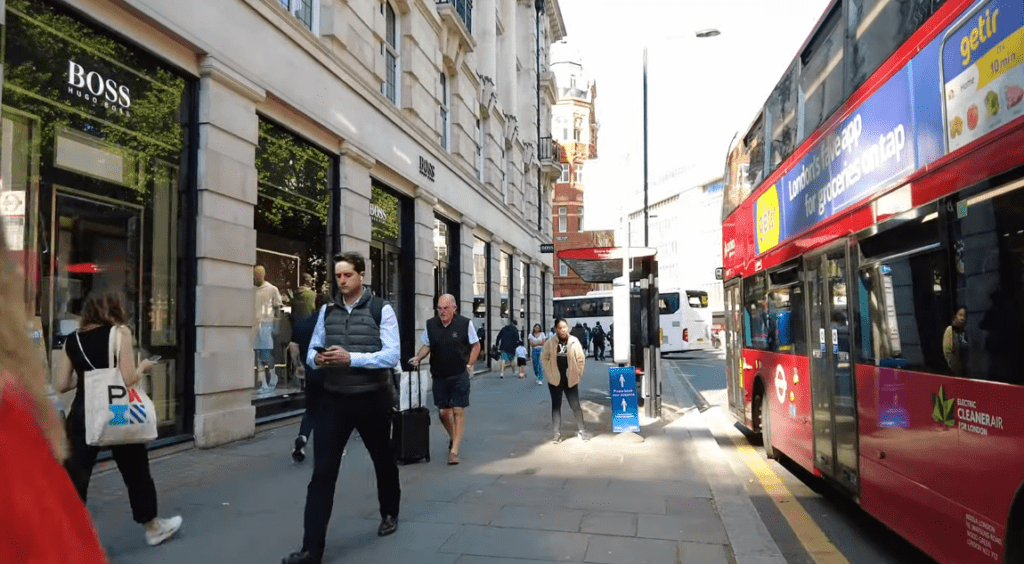
All of this never had a theoretical business case. Air France chose Wembley in northwest London over any other location in Europe when it decided to close nine European telephone reservation centers and consolidate them into a single location in the late 1990s. This decision was made purely for commercial reasons. The new center’s manager, Frederic Verdier, put it simply: London was the best place to hire multilingual employees. The same conclusion had already been reached by American airlines like Delta and TWA, who favored London as a hub for pan-European operations due to the city’s unparalleled language pool. That was back in 1999. In the decades that have passed, the reasoning has only grown stronger.
Although it differs from the concentrated ethnic geography of New York, where Marian Storkey of the London Research Centre observed that London’s communities were more dispersed, the geography of London’s linguistic diversity has its own internal logic. Totteridge and Finchley are the hubs of the Japanese community. the neighborhood of Barnet in Hong Kong. Stockwell is traversed by the Portuguese. Restaurant menus on Brick Lane still translate into Bengali almost automatically because the language is so deeply ingrained in Tower Hamlets. However, the linguistic texture changes if you walk a mile in any direction. Within London’s borders, there are 33 communities with more than 10,000 residents who were born outside of England, as well as 12 additional communities with more than 5,000 residents. Over 200,000 people who were born in Ireland, which has historically been one of the largest immigrant populations, have been joined, encircled, and overlaid by waves of new arrivals that have never stopped.
The city may never have made up its mind about what to do with this inheritance. With one city and more than 300 languages, the GLA’s City of Languages initiative appropriately presents it as a cause for celebration. Language and culture classes are supported by the Greater London Authority, and the numbers are not insignificant. However, in London’s schools, where EAL caseloads are among the highest in Europe, the topic of discussion can quickly change from resource to problem that needs to be managed, or from asset to administrative challenge. The conflict between the institutional challenges of supporting all those languages and their cultural and economic worth permeates London’s self-perception in ways that have never been entirely resolved.
It seems as though the city has created something truly remarkable without ever fully committing to it as a conscious project when you stand on any busy London street and listen to what it actually sounds like. In 2020, The Spectator stated that London’s hundreds of languages were the city’s greatest asset. This is a startling statement in a publication that doesn’t usually celebrate immigration. However, it was also just true. Arrivals founded London, and they have continued to shape it ever since. The languages are not a byproduct of that past. They are still being spoken and serve as its record.
London Bilingualism's content on health, medicine, and weight loss is solely meant for general educational and informational purposes. This website does not offer any diagnosis, treatment recommendations, or medical advice.
We consistently compile and disseminate the most recent information, findings, and advancements from the medical, health, and weight loss sectors. When content contains opinions, commentary, or viewpoints from professionals, industry leaders, or other people, it is published exactly as it is and reflects those people's opinions rather than London Bilingualism's editorial stance.
We strongly advise all readers to consult a qualified medical professional before acting on any medical, health, dietary, or pharmaceutical information found on this website. Since every person's health situation is different, only a qualified healthcare provider who is familiar with your medical history can offer you advice that is suitable for you.
In a similar vein, any legal, regulatory, or compliance-related information found on this platform is provided solely for informational purposes and should not be used without first obtaining independent legal counsel from a licensed attorney.
You understand and agree that London Bilingualism, its editors, contributors, and affiliated parties are not responsible for any decisions made using the information on this website.