

Every day, without giving it much thought, Coreyanne Russell, a science teacher at Fort Vancouver High School in southwest Washington, witnesses her students accomplish something remarkable. There are more than 35 languages spoken there, and when students who speak the same language end up sitting close to one another, the conversation changes—sometimes within a single sentence. English is influenced by Spanish. Somali to English. The body becomes more relaxed. The tempo quickens. The words sound different, as though something that had been somewhat restrained has been released.
Code-switching is the term for what those students are doing, and the workings of their brains during this process are the focus of an expanding corpus of neuroscience research that is subtly changing our understanding of language, cognition, and the structure of the human mind.
For many years, it was widely believed that bilingual people who spoke more than one language were somehow being imprecise. Perhaps confused. lazy when it comes to grammar. It turns out that the opposite is more accurate. When a bilingual person switches between languages in the middle of a sentence, they are not simplifying their cognitive task; rather, they are making it much more complex, and their brain is rising to meet that complexity in ways that monolingual brains hardly ever need to.
In 2021, NYU graduate linguistics student Sarah Frances Phillips and her adviser Liina Pylkkänen published brain imaging research demonstrating that bilingual speakers use the same core brain regions for code-switching that monolingual speakers use to process words, and that the transitions occur with a fluency and naturalness that the imagery clearly reflected. The next year, Angélique Blackburn and Nicole Wicha of the National Institutes of Health conducted a more thorough study that tracked precisely what happens when a Spanish-English bilingual reader comes across a code-switch in a sentence using event-related potentials, which are the exact timing of electrical brain activity measured in milliseconds. The N400, a brain response that consistently fires when a word doesn’t fit its context, was the discovery that shocked them the most. There was no N400 spike when a code-switched word appeared in the middle of a sentence in the other language. Regardless of the language the word came from, the brain was instantly accessing meaning. The meaning itself was immediately understood, but the cost of the switch became apparent later, during the integration stage, which is when the brain incorporates the word into the continuing sentence.
| Topic | Neuroscience of Code-Switching in Bilingual and Multilingual Brains |
|---|---|
| Key Research — NYU | Sarah Frances Phillips (NYU Linguist/Graduate Student) and Liina Pylkkänen (Adviser) — brain imaging study on code-switching, published November 2021 |
| Published In | Scientific American Mind, March 2022 |
| Key Research — ERP Study | Angélique M. Blackburn and Nicole Y.Y. Wicha — “The Effect of Code-Switching Experience on the Neural Response Elicited to a Sentential Code Switch” |
| Published In | Languages (Basel), July 2022; PMC (NIHMSID: NIHMS1834712) |
| Study Participants | 24 Spanish-English balanced bilinguals |
| Key ERP Measures | N400, Left Anterior Negativity (LAN), Late Positive Component (LPC) |
| Key Finding | Early semantic access (N400) unaffected by language switch; code-switching affects later integration stage (LPC) |
| School Observed | Fort Vancouver High School, Southwest Washington (35+ languages spoken) |
| NW Noggin Author | Zulyed Guerra, undergraduate at Portland State University (Public Health/Interdisciplinary Neuroscience) |
| Teacher Quoted | Coreyanne Russell, Science Teacher, Fort Vancouver High School |
| Key Brain Regions | Broca’s Area (left frontal); Wernicke’s Area (posterior temporal); Anterior Cingulate Cortex; Dorsolateral Prefrontal Cortex; Left Inferior Frontal Gyrus |
| Key Concept | Both languages remain simultaneously active in the bilingual brain; dominant language must be inhibited during code-switching |
| University of Maryland Study | Salig (2025) — code-switches heighten bilinguals’ attention to speech signal |
| BBC Coverage | “How Our Brains Cope With Speaking More Than One Language” (July 2022) |
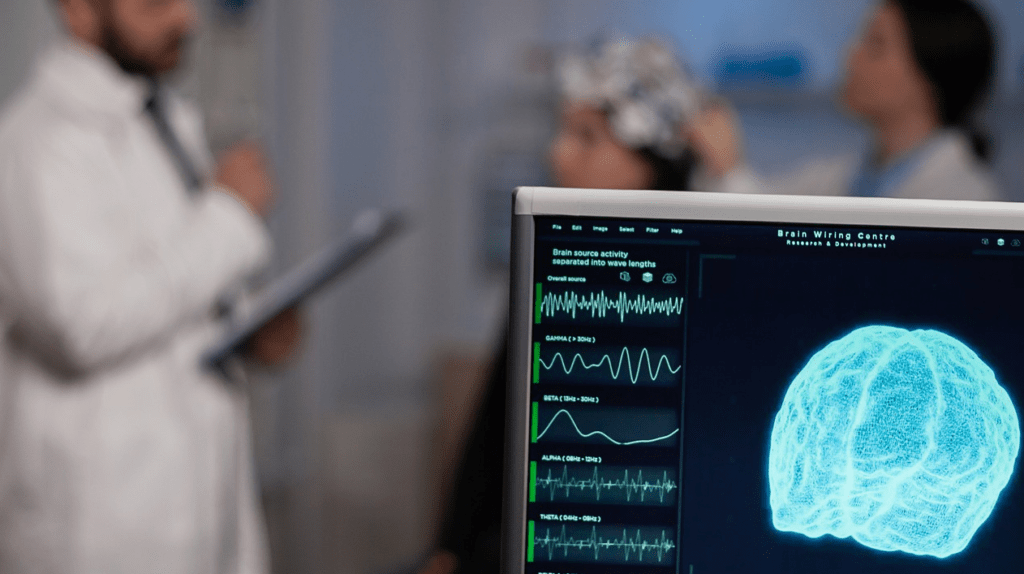
That implies something significant about the structure of the bilingual mind. Both languages are constantly in use. Constantly accessible. They are not kept in distinct rooms with doors between them in the brain. They coexist in overlapping networks, and code-switching is more akin to conducting two orchestras at the same time, keeping one slightly suppressed while the other plays, and fluidly shifting the emphasis in real time. The conflict between the rival languages is observed by the anterior cingulate cortex. The working memory needed to suppress language that isn’t being used right now is managed by the dorsolateral prefrontal cortex. Whichever language is currently in use, Broca’s area chooses the proper grammatical structure. All of this occurs in a matter of milliseconds, mostly without conscious awareness.
Zulyed Guerra, an undergraduate studying public health and neuroscience at Portland State University, was raised speaking Spanish at home and English at school. She was always switching between the two languages without realizing what it was or what her brain was doing. Since then, she has written thoughtfully about it, pointing out that code-switching can be both a cognitive advantage and a social burden. The former is because learning two languages improves executive control, working memory, and the kind of cognitive flexibility that researchers have linked to benefits in attention and problem-solving; the latter is because many people are under pressure to code-switch. It is a reaction to prejudice, anxiety in the workplace, and the real-life experience of knowing that your natural voice will be assessed differently in various settings.
The disparity between what neuroscience has learned about the bilingual brain and how bilingual speakers are occasionally treated in educational, professional, and medical contexts is difficult to ignore. According to science, the code-switcher is performing an amazing cognitive function. Sometimes the social context dictates that they should only speak one language and stick with it. Perhaps the most bilingual scenario of all is that both events are occurring at the same time.
London Bilingualism's content on health, medicine, and weight loss is solely meant for general educational and informational purposes. This website does not offer any diagnosis, treatment recommendations, or medical advice.
We consistently compile and disseminate the most recent information, findings, and advancements from the medical, health, and weight loss sectors. When content contains opinions, commentary, or viewpoints from professionals, industry leaders, or other people, it is published exactly as it is and reflects those people's opinions rather than London Bilingualism's editorial stance.
We strongly advise all readers to consult a qualified medical professional before acting on any medical, health, dietary, or pharmaceutical information found on this website. Since every person's health situation is different, only a qualified healthcare provider who is familiar with your medical history can offer you advice that is suitable for you.
In a similar vein, any legal, regulatory, or compliance-related information found on this platform is provided solely for informational purposes and should not be used without first obtaining independent legal counsel from a licensed attorney.
You understand and agree that London Bilingualism, its editors, contributors, and affiliated parties are not responsible for any decisions made using the information on this website.
