

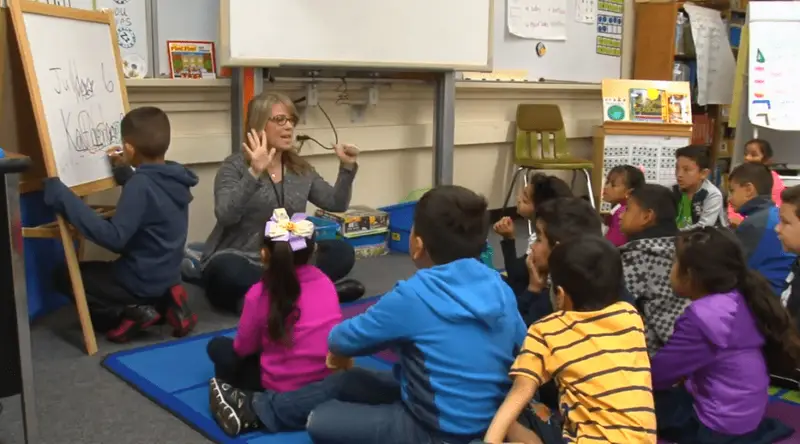
On any given Tuesday morning, you’ll notice something that takes some time to comprehend if you walk into a dual language elementary school in Brooklyn or Albuquerque. Spanish is used for half of the lesson. English is used in the other half. The kids switch between them with the ease of someone who has never been informed that this is supposed to be challenging. There isn’t any obvious confusion. Nobody appears to be lost. In contrast to what you’d see in a typical English-only classroom, where the pressure of standardized testing is written into every surface, the teacher moves through the room asking questions in one language and accepting answers in the other. The whole thing proceeds with a kind of unhurried confidence that is, to be honest, striking.
For many years, this approach—dual language bilingual education, as it is currently preferred—has been yielding favorable outcomes. The study is not brand-new. The political pressure against it is new, coming at a time when the evidence for its efficacy has never been stronger or more compelling.
In one of the most methodologically rigorous studies of its kind, American University researcher Jennifer Steele’s four-year randomized trial revealed that dual-language students performed better than their English-only counterparts. Not even close. consistently over a number of years and measures. Maintaining dual language and bilingual programs clearly outperform English-only or transitional programs on achievement, attainment, and a variety of other outcomes, according to the accumulated research cited by Patricia G.”ara at UCLA and Kathy Escamilla at the University of Colorado Boulder. Participation in dual language programs lowers peer victimization among English language learners, according to additional research from Springer. This finding doesn’t always make headlines in education policy, but it probably should.
| Topic | Dual Language Bilingual Education (DLBE) in American public schools |
|---|---|
| Key Researchers | Patricia Gándara (UCLA); Kathy Escamilla (University of Colorado Boulder); Jennifer Steele (American University) |
| Jennifer Steele Study | Four-year randomized trial at American University found dual-language students outperformed English-only peers |
| Student Population | More than 1 in 5 US students speaks a primary language other than English at home |
| Family Opinion (2026) | 94% of non-English-speaking families said bilingual education was “very” important (The 74, January 2026 polling) |
| Key Finding | Research shows clear advantage for “maintenance” dual language and bilingual programs over English-only or transitional programs for achievement, attainment, and multiple other outcomes |
| Additional Finding | Participation in dual language programs reduces peer victimization among English learners relative to English-only programs |
| Policy Tension | Trump administration pushing English-only policies; approximately 30 states have English-only laws for government communications |
| Key Terminology Shift | From “Limited English Proficiency” (deficit framing) to “Emergent Bilingual” (asset framing) |
| Primary Obstacles | Shortage of qualified bilingual teachers; English-only standardized testing that doesn’t measure bilingual gains |
| Published Research | Rutgers University (Dontamsetti et al., Encyclopedia, December 2025); Gándara & Escamilla, Springer (2017) |
In the meantime, 94% of families who speak a language other than English at home said that bilingual education is very important to them, according to a January 2026 survey. Not very significant. Really. There is a significant discrepancy between what families desire, what research supports, and what federal policy is currently promoting. An educational consensus that has been developing for decades is directly at odds with the Trump administration’s English-only messaging and the approximately thirty states that already have English-only laws for government communications.
It’s important to preserve this historical context. Languages other than English have never been considered resources in the United States. The default American stance has been that other languages are challenges to be solved rather than assets to be developed, from the suppression of Native American languages in federal boarding schools to the English-only ballot initiatives of the 1990s to the dismantling of California’s bilingual education programs in 1998 (later overturned by voters in 2016). This ideology has been uncomfortably precisely tracked by the terminology. For many years, students who did not speak English at home were labeled as having “limited English proficiency”—a term based solely on deficiency. Instead of listing the child’s deficiencies, the field has been shifting toward the term “emergent bilingual,” which recognizes what the child already possesses. The implication is substantial despite the slight change in language.
The business case for bilingual education has never been stronger, which makes the current situation especially peculiar. Between 2010 and 2015, the number of job postings in the US that required bilingualism doubled. The media, engineering, and finance sectors had the fastest-growing demand. Nowadays, one in five American students speaks a language other than English at home. These kids don’t require correction. These are kids who could graduate into a job market that is actively looking for precisely the skill set they already possess if they receive the proper educational support.
Whether any of this will change federal policy in the near future is still unknown. The political winds are blowing in the other direction. However, classes are still being taught in the dual language classrooms in Albuquerque and Brooklyn. The kids are switching between Spanish and English as if it were the most natural thing in the world. Because it is for them.
London Bilingualism's content on health, medicine, and weight loss is solely meant for general educational and informational purposes. This website does not offer any diagnosis, treatment recommendations, or medical advice.
We consistently compile and disseminate the most recent information, findings, and advancements from the medical, health, and weight loss sectors. When content contains opinions, commentary, or viewpoints from professionals, industry leaders, or other people, it is published exactly as it is and reflects those people's opinions rather than London Bilingualism's editorial stance.
We strongly advise all readers to consult a qualified medical professional before acting on any medical, health, dietary, or pharmaceutical information found on this website. Since every person's health situation is different, only a qualified healthcare provider who is familiar with your medical history can offer you advice that is suitable for you.
In a similar vein, any legal, regulatory, or compliance-related information found on this platform is provided solely for informational purposes and should not be used without first obtaining independent legal counsel from a licensed attorney.
You understand and agree that London Bilingualism, its editors, contributors, and affiliated parties are not responsible for any decisions made using the information on this website.
