

When you stroll through Camden on any given morning, the city’s linguistic character becomes apparent before you’ve even traveled fifty meters. Two women are talking in what sounds like Somali outside the cafés on Kentish Town Road. A father looks at an English notice board while explaining something to his daughter in what appears to be Bengali on the Camden Town Tube platform. Construction workers are exchanging instructions in Portuguese, or perhaps Brazilian Portuguese, near the canal at King’s Cross. The distinction is important, and no one appears to be confused by it. Multiculturalism is not being performed here. It’s just the sound of the neighborhood waking up.
Camden is one of the most linguistically diverse areas in Britain, with more than 140 languages spoken there, but the sheer number is hardly significant. The way the borough has chosen to handle that complexity is what makes Camden worth closely examining and something that resembles a functional model for urban language policy. Not as an issue to be resolved, not as a communication burden to be reduced, but rather as a significant asset that influences public space design, school administration, and the council’s future views on civic identity. It is less common than it ought to be for that choice to be made clearly and incorporated into formal strategy as opposed to just being stated in speeches.
Sociologist Steven Vertovec first used the term “super-diversity” in 2005 to characterize a situation in large cities where diversity had surpassed the more traditional classifications of minority and majority communities. Not only are there many different nationalities, but they also come with varying legal statuses, varying socioeconomic paths, varying ties to their first and second languages, and varying expectations for their duration of stay. Camden is a perfect example of this. The borough’s demographic profile is not dominated by any one ethnic or linguistic group. White people make up about 60% of the population, but White British people make up 40% and White Other people make up 20% of that group. These two groups have quite different linguistic backgrounds. There are substantial populations of speakers of Arabic, Spanish, French, and Bengali. Additionally, the population is constantly changing; in 2021 alone, over 26,000 people moved out and over 22,000 moved in, with another flow coming from outside the UK.
| Category | Details |
|---|---|
| Borough | London Borough of Camden |
| Established | 1965 (merger of Holborn, St Pancras, Hampstead) |
| Population (2025 est.) | Approx. 219,900–274,000 (estimates vary by source) |
| Languages Spoken | 140+ by residents; 174+ languages and dialects in schools (2023) |
| Non-English Main Language (2021) | 21.3% of residents |
| Top Non-English Languages | French (2.2%), Bengali/Sylheti (2%), Spanish (1.7%) |
| Primary Pupils with Non-English First Language | ~61.9% — significantly above London average |
| Born Outside UK | 54.6% of residents |
| Key Policy Initiative | Strategy for Diversity in the Public Realm (2023–2028) |
| Education Framework | Education Strategy to 2030; supplementary schools for mother-tongue learning |
| Diversity Goal | We Make Camden: public leadership to reflect community diversity by 2030 |
| Deprivation | Kilburn, Camden Town, St Pancras & Somers Town among most deprived wards |
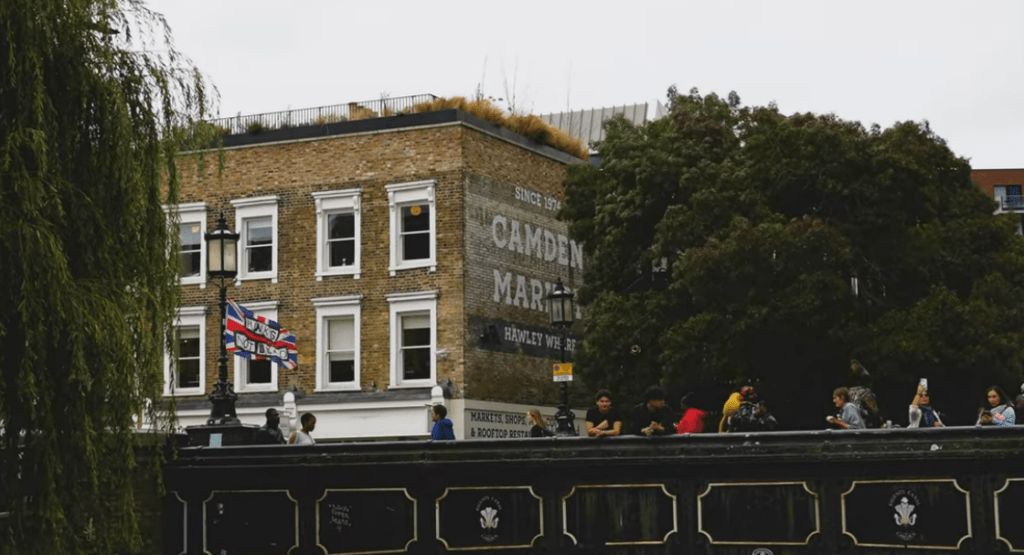
The linguistic picture is further enhanced by what takes place in Camden’s classrooms. More than 174 different languages and dialects were spoken by students in Camden schools in 2023; this number nearly defies easy comprehension. Additionally, 62% of elementary school students speak a language other than English as their first language, which is significantly higher than the London average. Before they start school, these kids are frequently already bilingual or multilingual. The issue facing the educational system is not whether or not to accept that reality, but rather what to do with it. Camden’s solution, which is incorporated into its Education Strategy to 2030, is to view multilingualism as a resource rather than a problem. This includes creating a curriculum that, in the words of the strategy, guarantees that every child recognizes themselves in what they are learning and supporting supplementary schools where kids can develop their mother tongues in addition to English.
From the outside, it’s difficult not to feel that Camden is accomplishing something that the majority of urban Britain still finds difficult to describe, let alone accomplish. The council’s cabinet approved the 2023 Strategy for Diversity in the Public Realm, which takes a five-year approach to how the borough’s linguistic and ethnic reality can be reflected rather than diminished in public areas, libraries, streets, and cultural events. A virtual Camden People’s Museum will be created, public art honoring diverse communities will be commissioned, and QR codes will be used to provide layered interpretation of already-existing statues and memorials. It’s an effort to make the borough’s physical fabric speak to its actual residents rather than just a more limited version of Camden’s past.
There is tension in all of this. The borough’s deprivation maps present a more unsettling picture. Kilburn, Camden Town, and St Pancras & Somers Town are consistently listed as the most deprived wards based on a variety of factors, including employment, housing, health, and income. The borough’s economic disparity and linguistic diversity are intertwined. The We Make Camden framework specifically addresses inequality in housing, employment opportunities, and educational attainment as part of the same strategic conversation as diversity and inclusion, and the council recognizes this overlap. That’s the correct framing, but there is still a significant gap between recognizing an issue and finding a solution.
Even though Camden’s approach is flawed, still developing, and sometimes contested, there is a sense that it offers something that the national discourse on immigration, bilingualism, and belonging is generally too hesitant to state clearly: that speaking multiple languages is not a sign of a deficiency that needs to be corrected, and that cities constructed from diverse linguistic communities are not problem-solving cities. They are cities with a resource. Camden is gradually constructing an institutional response to that assertion, not merely a stance on policy but an architecture. The next ten years in British urban policy will likely provide an answer to the question of whether it persists and spreads.
London Bilingualism's content on health, medicine, and weight loss is solely meant for general educational and informational purposes. This website does not offer any diagnosis, treatment recommendations, or medical advice.
We consistently compile and disseminate the most recent information, findings, and advancements from the medical, health, and weight loss sectors. When content contains opinions, commentary, or viewpoints from professionals, industry leaders, or other people, it is published exactly as it is and reflects those people's opinions rather than London Bilingualism's editorial stance.
We strongly advise all readers to consult a qualified medical professional before acting on any medical, health, dietary, or pharmaceutical information found on this website. Since every person's health situation is different, only a qualified healthcare provider who is familiar with your medical history can offer you advice that is suitable for you.
In a similar vein, any legal, regulatory, or compliance-related information found on this platform is provided solely for informational purposes and should not be used without first obtaining independent legal counsel from a licensed attorney.
You understand and agree that London Bilingualism, its editors, contributors, and affiliated parties are not responsible for any decisions made using the information on this website.
